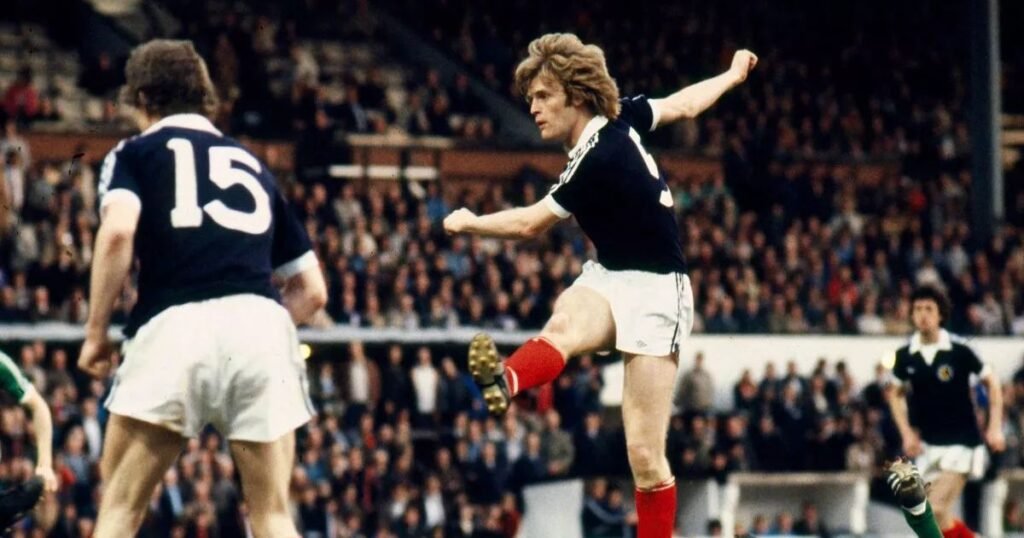
A landmark inquest has concluded that the repetitive heading of a football “likely” contributed to the brain disease that led to the death of Scotland and Manchester United legend Gordon McQueen.
McQueen, a towering central defender who earned 30 caps for his country and made nearly 350 appearances for St Mirren, Leeds United, and Manchester United, passed away in 2023 at the age of 70. While originally diagnosed with vascular dementia, a Northallerton coroner’s court confirmed on Monday that Chronic Traumatic Encephalopathy (CTE)—a progressive brain condition caused by repeated head impacts—was a significant factor in his death.
‘Football Ultimately Took Him’
Senior coroner John Heath delivered a narrative verdict, stating he was satisfied on the “balance of probability” that the physical demands of McQueen’s career caused the underlying condition. The cause of death was officially recorded as pneumonia, vascular dementia, and CTE.
Outside the court, McQueen’s daughter, Sky Sports presenter Hayley McQueen, spoke emotionally about the toll the disease took on their family and the “horrendous” final years of her father’s life.
“Dad absolutely loved everything about football, but ultimately, it took him in the end,” she said. “CTE is very different from traditional dementia. It depleted my parents’ lifetime savings looking for private care. My dad’s main message would be to warn others against the dangers of heading to protect future generations. Football is a beautiful sport, but it doesn’t need to take people’s lives.”
The Medical Evidence: Defenders at Higher Risk
The court heard expert testimony from Professor Willie Stewart, a world-leading consultant neuropathologist based in Glasgow, who examined McQueen’s brain post-mortem. He described finding a torn membrane and evidence of CTE in multiple locations.
Prof. Stewart noted that the symptoms of CTE—including cognitive decline and neuro-behavioural changes—are increasingly typical in professional football and rugby players. Crucially, he highlighted that goalkeepers show a risk level equivalent to the general population, whereas outfield defenders face a significantly heightened risk due to the frequency of heading the ball.
Pressure Mounts on Football Authorities
The verdict comes amid growing scrutiny over how football protects its players. A 2019 study co-funded by the FA and PFA found that professional footballers were 3.5 times more likely to die from neurodegenerative diseases than the general population.
Luke Griggs, chief executive of brain injury association Headway UK, described the verdict as a “sizeable and important moment,” noting that the link between repeated head trauma and conditions like CTE is now “well established” by peer-reviewed evidence.
While the FA currently funds a Brain Health Fund to assist affected families, today’s verdict is expected to intensify calls for stricter heading limits in training and better long-term support for veterans of McQueen’s generation.
Rest in Peace, Gordon McQueen (1952–2023). A true giant of the Scottish game.