
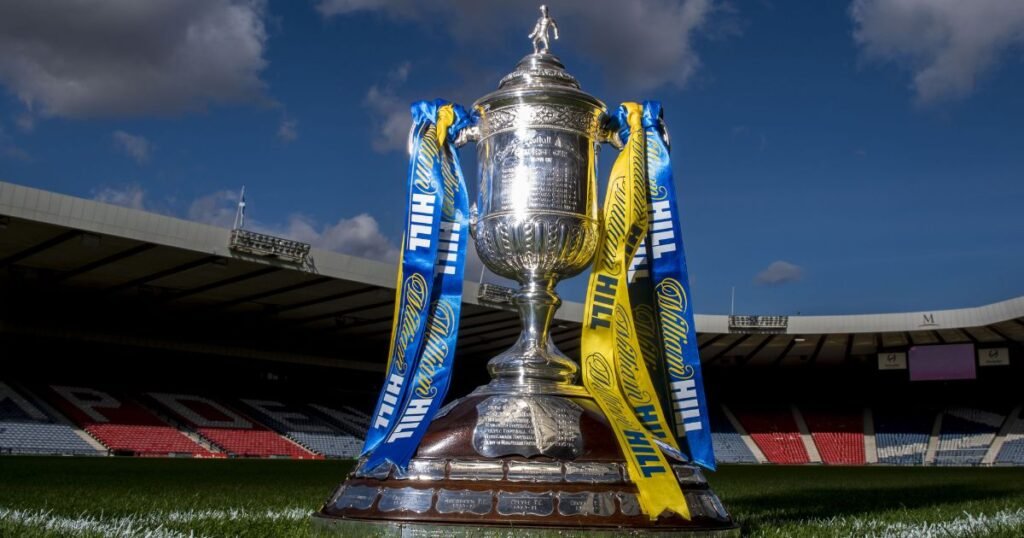
The Scottish Cup holds a unique place in world football history. First contested in 1873–74, it is the oldest national football cup competition in the world, predating the FA Cup and remaining a defining part of the Scottish football calendar.
Organised by the Scottish Football Association (SFA), the competition has produced generations of drama, romance, and unforgettable occasions, from packed finals at Hampden Park to famous giant-killings in towns and villages across the country.
The Origins of the Scottish Cup
The Scottish Cup was established just one year after the formation of the SFA. The inaugural tournament featured 16 clubs, with Queen’s Park emerging as the first winners after defeating Clydesdale in the final.
In its early years, Queen’s Park dominated the competition, reflecting their pioneering role in shaping the passing game. As professionalism arrived in Scottish football, the Cup evolved into a truly national contest, welcoming clubs from all levels of the pyramid.
More on the competition’s early years can be found via the Scottish FA official Scottish Cup history.
Most Successful Scottish Cup Winners
The Scottish Cup roll of honour is dominated by the Old Firm. Celtic are the most successful club in the competition’s history, with over 40 Scottish Cup wins, while Rangers follow with more than 30 triumphs.
Outside Glasgow, Aberdeen and Hearts have enjoyed notable success, particularly during periods when Scottish football was more competitively balanced. Clubs such as Dundee United, Hibernian, and Kilmarnock have also etched their names into Cup folklore.
A full list of winners is available via Wikipedia’s Scottish Cup archive, which remains a widely referenced historical resource.
Iconic Scottish Cup Finals
The Scottish Cup final has long been the showpiece event of the domestic season. Traditionally held at Hampden Park, the final has produced some of the most iconic moments in Scottish sporting history.
The 1937 final between Celtic and Aberdeen remains the most attended domestic cup final anywhere in world football, with more than 147,000 spectators inside Hampden — a record that is unlikely ever to be broken.
More recent classics include Aberdeen’s dramatic 1990 victory over Celtic, sealed by Theo Snelders’ penalty save, and Inverness Caledonian Thistle’s 2015 triumph, one of the modern era’s great fairy-tale successes.
Giant Killings and Famous Shocks
The magic of the Scottish Cup lies in its openness. Clubs from League Two, the Highland League, and the Lowland League enter the competition each season, dreaming of a famous upset.
Perhaps the most famous giant-killing came in 2000, when Inverness Caledonian Thistle defeated Celtic 3–1 at Parkhead — a result that famously prompted the headline “Super Caley Go Ballistic, Celtic Are Atrocious”.
Such shocks underline why the Cup continues to capture attention in a modern era dominated by league formats and financial imbalance.
Record Holders and Legendary Figures
Many of Scottish football’s greatest names are synonymous with the Cup. Jimmy McGrory remains the competition’s all-time top goalscorer, while players such as Henrik Larsson and Ally McCoist produced countless decisive moments.
Among managers, Jock Stein and Walter Smith stand out for their sustained success, using the Scottish Cup to cement eras of dominance.
Details on historic Hampden finals can be explored further at Hampden Park’s official website.
The Scottish Cup in the Modern Era
Today’s Scottish Cup retains its traditional knockout format while embracing modern broadcasting and global audiences. The winner earns a place in European competition, adding further incentive and prestige.
Recent winners such as St Johnstone, who completed a historic domestic cup double in 2021, prove that the competition still offers opportunity beyond the traditional powerhouses.
Why the Scottish Cup Still Matters
More than 150 years on, the Scottish Cup remains a living link between football’s past and present. It represents community, history, and the enduring belief that on the right day, anything is possible.
As long as supporters pack grounds, lower-league clubs dream big, and silverware is lifted amid scenes of pure emotion, the Scottish Cup will continue to hold its place as one of football’s most treasured competitions.

Co-Founder of Fitba Focus and MMA UK. A lifelong Rangers fan and former player, he combines over a decade of sports media experience with a deep-seated passion for the Scottish game. From the Ibrox stands to the lower-league terraces, Frankie is dedicated to providing honest, fan-led analysis of the full Scottish pyramid.